

image2
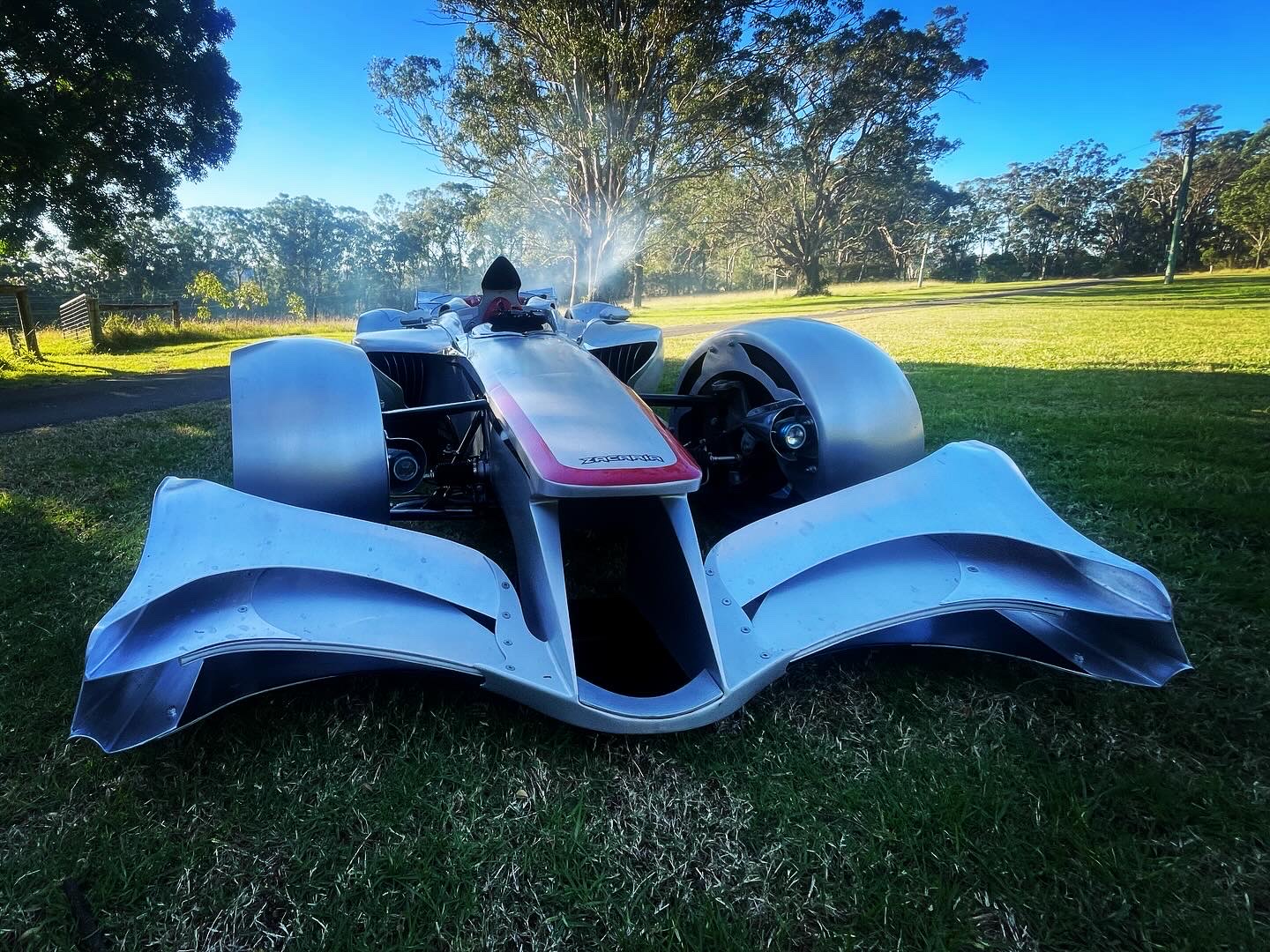
Inside the Street-Legal F1-Style Road Car Powered by a Ferrari V12 Engine
There are people who like Formula 1.
Then there are people who buy a team cap, maybe a jacket, perhaps a little bit of signed memorabilia, and call it passion.
And then there is Sydney-based F1 superfan Zac Mihajlovic, who looked at all the theatre, all the noise, all the speed and decided that simply watching it was nowhere near enough. So he spent around $1 million AUD building a street-legal F1-style road car powered by a Ferrari V12 engine. Not in a laboratory. Not with factory backing. Not because someone handed him a blank cheque and a design studio. But because the idea got stuck in his head and refused to leave.
Frankly, that is the sort of madness the car world needs more of.
It all started with the Australian Grand Prix
For Zac, this was not some random rich bloke fantasy cooked up after too much coffee (or VB). The seed was planted years earlier.
As he put it, “Attending the Australian Grand Prix in 2002 really planted the seed. The sound and speed of the cars were unforgettable, nothing else compares to a Formula 1 car at full noise.”
And he is right. A proper V10 Formula 1 car from 2002 does not just pass by, it assaults your senses. It arrives like a thunderclap and leaves your chest vibrating. You do not forget it.
Zac certainly did not.
He said, “At that stage, I had missed any real opportunity to pursue driving at that level, but I remember thinking, one day, I’d love to build something that captures what I felt that day, the theatre, the presence, the raw emotion.”
That is the key to this whole story. This was never about building a toy. It was about bottling a feeling.

Why a Ferrari V12, of course
Now if you are going to do something this absurd, you cannot half-do it. You do not build an F1-style machine and drop in something dreary and forgettable. It needs a heart. A proper one. A magnificent one.
For Zac, there was only one answer.
“To me, a Ferrari V12 represents the pinnacle of internal combustion engines. The sound, the pedigree, the history, it’s unmatched.”
That is not marketing fluff. That is a man who understands exactly what sort of engine belongs in a machine like this. A Ferrari V12 is not simply an engine. It is a declaration. It is noise, mythology and mechanical beauty all rolled into one red-blooded masterpiece.
Zac went even further, saying, “They’re also incredibly well engineered, reliable when maintained properly, and visually beautiful. If you’re building something inspired by Formula 1, a Ferrari V12 engine like the one I found on eBay feels the most authentic and emotional choice.”
Authentic and emotional. That is the whole point. This was not just about performance figures. It was about soul.
Bought on eBay, because apparently that is where dreams live now
This may be the most brilliant part of the story.
After sketching the idea on a napkin in 2015, Zac set alerts for “Ferrari V12” and eventually sourced the engine from a wrecked Ferrari in London through eBay. Most people use eBay to buy old car badges, jackets, watches, or things they absolutely do not need after 11 pm. Zac used it to source the centrepiece of one of the wildest road cars Australia has ever seen.
And honestly, his reasoning makes perfect sense.

“For Australians especially, eBay opens up the entire world. It removes geographical limits.”
Exactly. We are not sitting in Italy with Ferrari V12s lying around the neighbourhood like fallen gum leaves. If you want something rare, exotic and deeply expensive, you need reach.
Zac explained it plainly, “I actually sourced the Ferrari V12 engine from a seller in England through eBay. Without a global marketplace like that, finding the right engine in the right condition would have been far more difficult.”
That is the modern car scene in a nutshell. The internet has turned obsessive dreams into actual possibilities.
Yes, he really bought a Ferrari V12 online
Naturally, most people would need a little convincing before handing over serious money for an engine on the internet. Quite right too. One wrong move and you could end up with an empty bank account and a pallet full of disappointment.
But Zac had his reasons.
“It came down to a combination of the seller’s reputation and eBay’s review system, along with secure payment protection.”
And that matters when the part in question is not a mirror cap or an old steering wheel. It is the beating heart of your million-dollar vision.
He added, “When you’re making a purchase of that scale, transparency and accountability matter. The platform gave me the confidence that the transaction was protected.”
That confidence paid off in spectacular fashion.
Seven years of engineering, design and persistence
This was not a quick lockdown project. It was not one of those things people brag about over dinner and quietly abandon six months later when reality barges in with invoices.
This took years.
“The concept began around 2012. It was a long, evolving journey of engineering, design and refinement.”
That is a wonderfully calm way of describing something that must have involved moments of sheer chaos, financial terror and enough engineering headaches to make a lesser man pack it in and buy a nice normal sports car instead.
But Zac stuck with it.
“We were very close to completion when we flew to Monaco in May 2019 for the world premiere. So from initial idea to unveiling, it was roughly seven years of work.”
Seven years. That is not enthusiasm. That is obsession. The good kind.
Making it street legal in Australia, which is where things get properly difficult
Of course, building something mad is one thing. Making it legal is another entirely.
Australia is not exactly known for casually waving through home-built Formula 1-style monsters with a cheerful thumbs up. Compliance here is serious business, and Zac ran headfirst into that reality.
As he explained, “Australia has very strict engineering and compliance laws, especially for a vehicle like this.”
No kidding.
One of the toughest parts was making sure the car could meet emissions requirements while still feeling true to the original vision.
“One of the biggest challenges was sourcing a near-new engine to ensure we could meet emissions requirements. At the same time, I was determined to keep the car visually and emotionally authentic to a Formula 1 car.”
That balancing act must have been a nightmare. Because the minute you start softening something like this too much, you risk losing the very thing that made it exciting in the first place.
Zac summed it up perfectly, “Balancing authenticity with legal compliance was one of the hardest parts of the entire build.”
And yet he managed it. Which is frankly astonishing.
What it feels like to drive
Now this is the bit everyone wants to know. What is it actually like to drive a street-legal F1-style road car powered by a Ferrari V12 engine on public roads?
Zac’s answer is brilliantly understated.
“It’s honestly hard to put into words!”
Fair enough.
Then he gets to the good stuff.
“You’re sitting incredibly low to the ground, and having a V12 directly behind your ears adds a level of theatre that very few road cars can replicate. It’s raw, mechanical and completely immersive.”

That is exactly how it should be. Not filtered. Not polished. Not softened by layers of digital trickery and synthetic nonsense pumped through speakers. Raw. Mechanical. Immersive.
You can practically hear it from that sentence alone.
Monaco, royalty and a world premiere nobody will ever forget
Most project cars get unveiled in a shed, or maybe in a car park with a few mates standing around and someone holding a sausage roll.
This one was different.
Zac flew the car to Monaco ahead of the Monaco Grand Prix for its world premiere in 2019. That alone is gloriously over the top. But then it became even better, because Prince Albert II of Monaco unveiled it.
Let us just pause there for a second.
A napkin sketch in Australia turned into a Ferrari V12-powered road car unveiled in Monaco by royalty. That is not just a good story, that is outrageous.
And for Zac, the moment meant even more because his grandfather was there to witness it.
“Having Albert II, Prince of Monaco unveil it at its world premiere, with my 88-year-old grandfather there, was a moment I’ll never forget.”
That line tells you everything. Beneath the engineering and the spectacle, this was deeply personal.
Jenson Button drove it, because obviously he did
As if the Monaco debut was not enough, Zac’s one-off machine also ended up being driven by 2009 Formula 1 World Champion Jenson Button.
Again, this is the sort of thing that sounds made up. Yet here we are.
Zac said, “It was surreal to have had Jenson Button, the 2009 Formula 1 World Champion, drive it and provide feedback.”
Surreal is probably putting it mildly. Most enthusiasts would be thrilled if an ex-racer looked at their project and said, “nice work.” Zac handed the keys to a world champion.
Why he has turned down multi-million-dollar offers
And this is where the story gets its heart.
Yes, the car is spectacular. Yes, it is valuable. Yes, people have tried to buy it. But Zac has said no, even to offers worth millions.
Why?
Because some things are bigger than money.
“The experiences this car has given me are priceless.”
That is it. That is the answer.
He continued, “But beyond the public moments, this was a true family build. I poured my heart and soul into it. It represents years of risk, belief, persistence and passion. You can’t really put a price on something like that.”
And no, you really cannot.
You can value the metal. You can estimate the engineering. You can put a figure on the Ferrari V12, the fabrication, the transport, the attention, the fame. But the meaning of it? The story? The family connection? The years of belief? Forget it. There is no spreadsheet for that.
Right on cue, Australia has gone Formula 1 mad
The timing of all this is spot on, because new eBay Australia data shows Formula 1 fandom in this country is climbing like mad.
Sales for Ayrton Senna memorabilia are up 1008 per cent. Ferrari team jackets have jumped 157 per cent. Oscar Piastri memorabilia is up 157 per cent, Max Verstappen memorabilia is up 155 per cent, and Red Bull Racing memorabilia has risen 112 per cent.
So yes, race fever is very real.
Asim Moheet, Category Lead of Parts and Accessories, put it this way: Australians are using eBay to chase their passions, from iconic driver memorabilia to rare Ferrari parts, whether they are collecting, trading or, like Zac, building something extraordinary.
That last bit matters. Most fandom lives on shelves, in display cabinets, or in wardrobes full of team merch. Zac took his fandom and turned it into something with wheels, twelve cylinders and enough theatre to stop traffic.
The final word
What makes this car so compelling is not just the engineering, or the money, or the sheer visual lunacy of it. It is the intent behind it.
This was built by someone who remembered exactly how Formula 1 made him feel and refused to let that feeling stay in the grandstands.
He wanted the theatre. He wanted the presence. He wanted the raw emotion.
And somehow, through years of work, risk, persistence and passion, he built exactly that.
A street-legal F1-style road car powered by a Ferrari V12 engine sounds like the sort of thing dreamt up after too much espresso and not enough common sense. In Zac Mihajlovic’s case, it became real.
And thank goodness for that, because the world is already full of sensible cars. What it needs, every now and then, is one completely mad Ferrari V12 monster built by a man who simply could not let the dream go.

Zachary Skinner is the editor of TechDrivePlay.com, where tech, cars and adventure share the fast lane.
A former snowboarding pro and programmer, he brings both creative flair and technical know-how to his reviews. From high-performance cars to clever gadgets, he explores how innovation shapes the way we move, connect and live.


