
As 2025 Ends, Gordon Dundas on Whisky’s 2026 Future

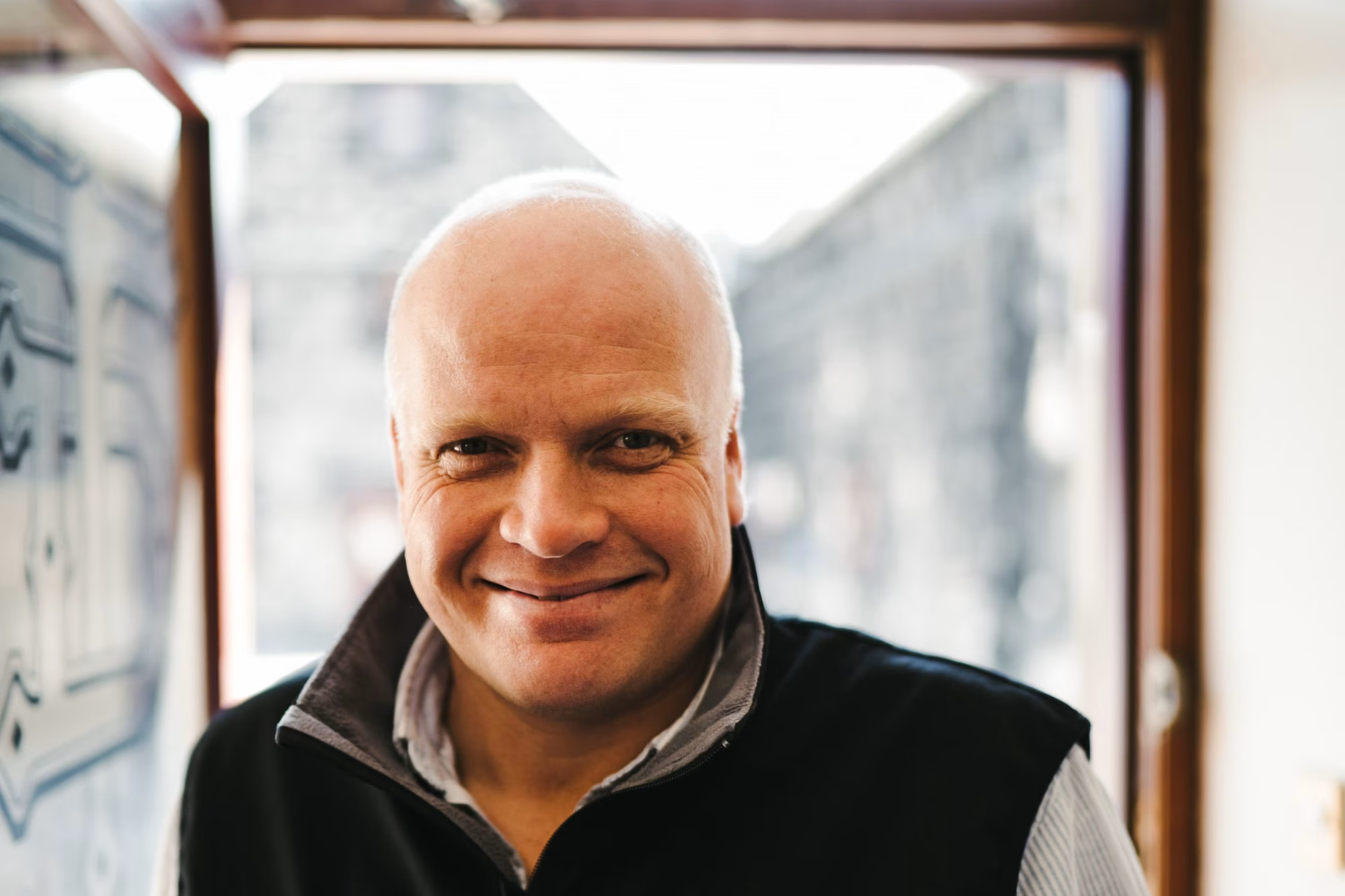
DSC 4738
If whisky were a car, 2025 would not be the year it smashes the throttle and disappears in a cloud of smoke. Which may annoy a few people who quite enjoyed the noise. There is no heroic redline charge, no chest beating about lap records. Instead, it has eased off, glanced at the fuel gauge, and settled into a steady cruise. Not because it is tired. Because doing everything flat out, all the time, usually ends with something expensive breaking.
That reading of the road comes from Gordon Dundas, a man who has been close enough to the whisky industry for long enough to know the difference between genuine trouble and a category simply catching its breath. Gordon is not a late arrival who wandered in during the boom, memorised a few tasting notes, and hung around for the free drams. He has been in the thick of it since the early 2000s, back when whisky was still something you had to explain to people, often more than once.
He cut his teeth at Whisky Magazine in 2003, back when whisky events were still convincing people they were worth turning up to, helping launch Whisky Live across the US, Asia, and Australia. From there, he moved on to represent some of the most serious names in the business as Global Brand Ambassador for Morrison Bowmore Distillers. Bowmore. Auchentoshan. Glen Garioch. Beam Suntory. This is not entry level stuff, and it never was.
In 2013, the industry tipped its hat properly, naming him a Keeper of the Quaich, which in whisky circles is about as close as you get to being knighted without having to kneel or swear loyalty to anyone in a tartan jacket.
Since 2017, Gordon has been the International Brand Ambassador for Ian MacLeod Distillers, the family owned company behind Glengoyne, Tamdhu, Smokehead, Edinburgh Gin, and the resurrection of the legendary Rosebank Distillery. And yes, that sounds dramatic, but it happens to be true.
So when Gordon talks about whisky slowing down, speeding up, or changing lanes altogether, he is not speculating from the sidelines. He is standing in the engine room, listening to the noise, feeling the vibration, and telling you exactly what the machine is doing.
Whisky in 2025, easing off, not giving up
So where does that leave whisky right now?
“I think it’s safe to say that whisky has slowed somewhat and has probably fallen in behind the pacemaker rather than leading the pack,” Dundas says. “That said, what we’ve seen in the past with whisky is that it’s been a little bit up and down. I see a bright future for the category in the next few years with innovation and the consumer want for more authenticity and provenance.”

This is an important distinction. Slowing is not the same as stalling. What Dundas is describing is a category that has stopped chasing growth for growth’s sake and started thinking about what it actually wants to be when it grows up.
The boom has not died, it has matured
Every few months someone declares that the whisky boom is over. Usually in a loud voice. Usually with very little context.
“We’ve had boom periods in the past,” Dundas says calmly. “I think there’s a little correction going on after COVID, as there probably is across a lot of categories and industries. Whisky will continue to be there in the future, providing a diverse range of flavours and taste for the consumer.”
COVID inflated everything. Prices, demand, expectations. What we are seeing now is gravity doing its job. Whisky is not collapsing. It is recalibrating.
Drinkers are braver, and a lot less precious
One of the most noticeable shifts in 2025 has been the behaviour of drinkers themselves.
“There has been a consumer shift for sure,” Dundas explains. “I think there are many more consumers looking to try new whiskies and become braver. There’s also a general trend to drinking more quality, which aligns so much with whisky, and that can be in any form, including cocktails.”
That last part matters. Whisky is no longer trapped in the idea that it must only be enjoyed neat, in silence, while staring into the middle distance. High quality whisky in cocktails is no longer heresy. It is progress.
Single malt still headlines, but blends are back in the conversation
For years, single malt was treated like the only answer worth giving.
“Single malt does tend to grab the headlines because of the diversity of it and the wide variety of tastes on offer,” Dundas says. “However, there will be more interaction from a blend perspective as well. There are some really fabulous blends which give such great flavours and taste. I don’t believe consumers see blends as inferior to single malt anymore, just different.”
This is a big shift. Blends are no longer the cheap alternative. They are becoming the smart choice for flavour, balance, and value.
This is not a crisis, it is a course correction
From the outside, recalibration can look like panic. From the inside, it looks like planning.
“I think there is a little bit of a recalibration going on,” Dundas says. “But ultimately, in the long term, whisky will be there and still offering what consumers want. There is a reason why we at Ian MacLeod Distillers are investing in distilleries and our brands for the long term.”
You do not invest in bricks, copper, and warehouses if you think the party is about to end.
Choice has exploded, and price now has a voice
Markets like Australia show just how broad whisky has become.
“With the rise of whisky around the world and its popularity in countries such as Australia, with your homegrown industry, there is so much more choice,” Dundas says. “That means there is a reason to try different styles and flavours, and even try them in different ways. Price is a feature more than it has been, and the consumers are moving around the category due to price, flavour and availability.”
Drinkers are no longer loyal to a single label out of habit. They are moving with purpose.
Age still comforts, but flavour wins arguments
Age statements still matter, but their authority is no longer absolute.
“Age is always a safety blanket for some people in terms of paying a certain amount for a bottle,” Dundas says. “What I would also say is age does not necessarily mean better. You can have some fantastic whiskies without an age that deliver a very different experience.”
Then he adds the caveat only a brand ambassador can deliver with a straight face.
“That said, when you drink a Glengoyne 30, it is quite special, exceptionally scarce and fully matured in sherry.”
Fair point.
Innovation is happening quietly, not loudly
Not every new distillery has thrived.
“There is no doubt there are some distilleries that have done amazingly well because the business model has been strong and anchored in quality,” Dundas says. “Unfortunately, there are others that will struggle in this environment.”
The real innovation is happening beneath the surface.
“We’re seeing more use of heritage barley, developments in yeast, and greater understanding of maturation,” he explains. “That already large sphere of taste becomes slightly bigger once these whiskies come to fruition.”
This is whisky thinking in decades, not quarters.
Consumers want truth, not just romance
Access to information has changed expectations.
“They want to know more about provenance, about the businesses behind their whiskies,” Dundas says. “Sustainability, production knowledge and cask provenance all feed into what consumers want to understand.”
Storytelling still matters, but it needs to be honest.
“As a family business, we are very strong on storytelling because our stories are engaging and anchored in quality whisky making,” Dundas says. “Being custodians of distilleries is a powerful way of showing that these places will exist long after we are gone.”
Looking toward 2026
When asked what comes next, Dundas does not hesitate.
“I think the rise of blends will be a major factor as consumers look to taste and price.”

Styles will remain market specific. Sherry casks in Asia. Peat where peat belongs.
“We are building a distillery on islands,” Dundas says. “So I am pretty hopeful peat will still continue to be a style people enjoy, in the right surroundings.”
Distilleries are also listening more closely than ever.
“We want to produce products that consumers want to consume. That is even more important now than it has been in the past.”
Geographically, Dundas sees the centre of gravity shifting.
“Ten years ago it was probably Asia driving innovation,” he says. “I think the US will be more dominant going forward. There is plenty of fantastic Scotch that can be relevant to a bourbon drinker, and that has not been explored enough.”
Prices, sustainability, and reality
Sustainability is not going away.
“Whether it is a selling point or not, sustainability is something we must continue to address as an industry,” Dundas says.
As for pricing, the chaos is easing.
“During COVID the cost of producing whisky was exceptional,” he explains. “Barley is expensive, power is still higher, and we are nowhere near pre COVID costs. But I do believe prices will remain relatively stable for the next year or so.”
One final prediction
If Dundas had one wish for the future, it is not a unicorn cask or a miracle yield.
“The rise of the highball,” he says. “It might take longer than 2026, but I would love to see the highball as popular and understood as a gin and tonic.”
Whisky in 2025 is not shouting anymore. It does not need to. It has slowed down, looked around, and remembered what made people fall in love with it in the first place. 2026, by the sound of it, is where it starts moving forward again.

Zachary Skinner is the editor of TechDrivePlay.com, where tech, cars and adventure share the fast lane.
A former snowboarding pro and programmer, he brings both creative flair and technical know-how to his reviews. From high-performance cars to clever gadgets, he explores how innovation shapes the way we move, connect and live.


